If you are worried about your spouse or partner’s drinking, you may have already reached a turning point – something changed in the relationship, or a consequence could no longer be explained away.
You may have counted their drinks without meaning to. You may have poured bottles away, made excuses to friends, started arguments you did not want to have, or gone quiet just to keep the peace.
This guide explains what actually helps when you love someone who is drinking too much, what tends to make things worse, and what you can do next.
Can an Alcoholic Partner Actually Change?
Yes.
People with alcohol use disorder recover every day, including people who have been drinking for decades and people who once swore they never would. There is no reason your partner has to be the exception.
Recovery is not usually quick, and it is rarely linear. It also requires their own sustained and consistent effort. Nobody recovers by accident, and nobody can be talked into recovery in a single conversation.
Change requires two things: their own effort and a shift in what surrounds them. The second part is where you come in – though probably not in the way you have been trying so far.
What Mindset Should I Have When Dealing With an Alcoholic Partner?
We would like to put this in two lines:
You did not cause it. You cannot control it.
Whatever was said during the last argument, your partner would be facing this with or without you. People develop alcohol problems through a complex combination of biological, psychological, social, and environmental factors- not because their partner works late or asks too many questions.
You are their partner. You are not their counsellor, doctor, or addiction therapist. Trying to be all three is one of the fastest routes to burnout.
Holding on to these three things is not giving up on your partner. It is putting your energy where it can actually make a difference.
Read Also: Alcoholism and Recovery: Understanding the Journey Back to Self
I’m Also a Moderate Drinker. Should I Stop?
If your partner is trying to stop drinking, this is one of the most useful changes you can make. At the very least, we recommend trying not to drink in front of them.
You may be perfectly comfortable having a glass of wine with dinner. But your partner may not be able to do what you can do. That is part of the condition.

You can have one drink and put the glass down, but for someone struggling with alcohol, once they start drinking, stopping can be extremely difficult or even impossible. That means watching you drink may not be a neutral experience for them.
None of this means giving up alcohol for life. For many couples, a workable approach is to have no alcohol in the house and not drink in front of them for the first few months, then have a conversation about what comes next.
4 Recommended Things You Should Do When Living With an Alcoholic Partner
- Keep the ordinary shape of your days. Have breakfast, lunch, and dinner at the usual times. Work, rest, and sleep as normally as possible. Routine can help steady everyone in the household, especially if you have children.
- Look after yourself, physically and mentally. Make sure you are still eating well, sleeping properly, and taking care of your mental health. Find one person you trust or a support system and tell them the truth out loud. Carrying this in secret is what breaks people.
- Let your partner face the consequences. You do not have to step in and rescue them every time something goes wrong.
For example, if they are too hungover to make it to the family lunch, then they miss the family lunch. Sometimes, you have to let it be.
This is one of the hardest habits to break because stepping in can feel like love. But when you clean up the mess, your partner never has to face the consequences. Sometimes, consequences are necessary for real change. - Look into what support actually exists. Counselling, support groups, day programmes, medically supervised detox, and residential treatment are all options to explore. Knowing what is available helps both of you. It gives you something specific to offer when they are ready, rather than simply saying, “You need help.” It also points you towards support for yourself, whether or not they accept it.
How to Talk With an Alcoholic Partner
We understand how you feel. Most of these conversations can easily go badly.
We recommend talking when they are sober.
Not on a night when they are intoxicated, and not the next morning while they are still ill and ashamed. Pick a quiet, private time when nothing else is about to happen.
Keep it short and focus on the current situation. Bringing up every incident from the last two years, for example, will probably be heard as an attack.
Talk about what you have noticed and how you feel, rather than telling them what they are.
“You are an alcoholic” invites an argument. Instead, try something like:
“I have noticed that you have been drinking every night, and I am frightened.”
This shows vulnerability rather than blame.
Here are some words for the moments that can be hardest to handle:
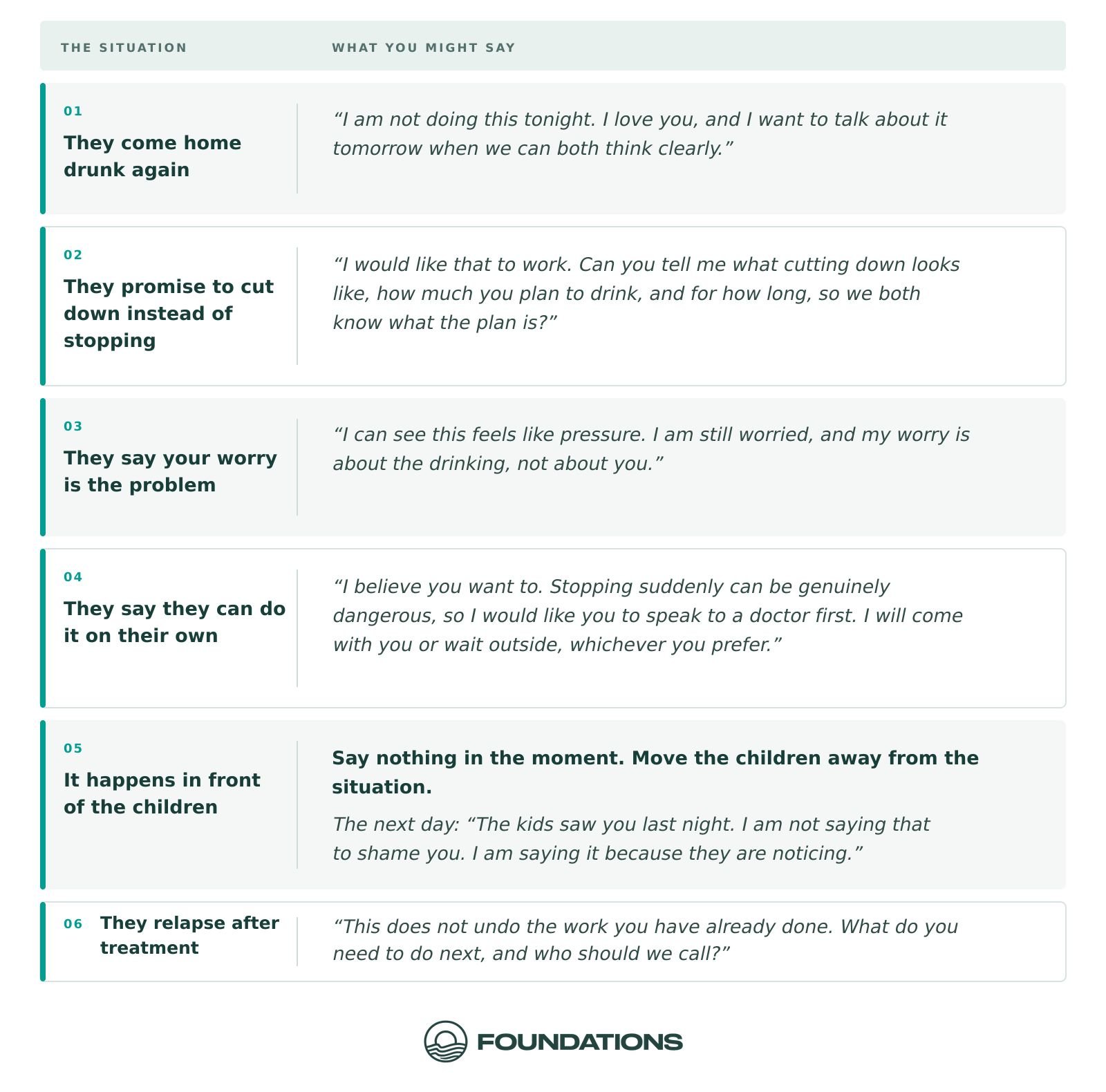
How Can I Encourage Them to Get Help?
There is a common belief that people have to hit rock bottom before they will accept help. We do not believe that.
We believe alcohol addiction can be addressed before it gets worse. Waiting for rock bottom can mean waiting for job losses, serious health problems, and sometimes much worse. We do not believe you have to wait for that to happen.
The section below covers how to talk to your partner about their drinking. These are some things that can make them more likely to accept help when you have that conversation.
Ask More Than You Tell
We see this a lot. You have told your partner what they should do more than once, probably not always in a calm tone – and that is understandable.
But it often ends with them defending their drinking rather than looking at it.
A genuine question can work differently because people are less likely to argue with a conclusion they reached themselves.
- “Have you ever thought that your drinking might be a problem?”
- “What do you like about drinking, and what do you not like?”
- “How do you feel the next morning?”
Then let them answer without correcting them. It shows that you are listening rather than simply waiting for your turn to speak, and it gives them an opportunity to hear their own contradictions out loud.
Put Yourself on Their Side
This works better when it feels like the two of you are against the drinking rather than you against them.
Tell them that you are on their team. Ask what kind of help would feel acceptable to them and what would make getting help easier.
Then offer something practical: drive them to an appointment, help them research treatment or rehabilitation options, or sit with them while they make the call to get help.
Be Clear About Your Own Limits
Encouragement works better when your partner knows where you stand.
The useful version is about what you will do, not what you will make them do. Tell them that you want to support them through this, but that you cannot continue living the way you are living now.
Only set boundaries that you are actually prepared to follow through on. A boundary you do not uphold can cost you the credibility you may need later.
Read Also: Alcohol and the Human Body: What Really Happens Inside
Are You Supporting a Partner Who Is Drinking Too Much?

You cannot make this decision for the person you love. You can make it easier for them to make the decision, and you can make sure you are still standing when they do.
If you are supporting a husband, wife, or partner who is drinking too much, you do not have to work out the whole future today. You just need to take the next step.
Talk to someone who understands. We will listen, answer your questions, and help you work out the safest next step privately and with no pressure to decide anything on the call.