If you have started looking into rehab in Australia, one of the first practical questions is likely to be a simple one: how much is this actually going to cost?
The frustrating answer is that there is no single price for rehab in Australia.
Publicly funded alcohol and drug treatment can be free. Private residential treatment can cost tens of thousands of dollars. Private health insurance may contribute towards some hospital-based treatment, while other private residential programmes are largely self-funded. The length of treatment, whether you need medical detox, the level of clinical support and even what is included in the quoted price can all make a significant difference.
If you are considering travelling to Bali for treatment, there is another calculation to make. You need to compare the full cost of treatment in Australia with the programme, accommodation, care and additional travel costs involved in going overseas.
This guide breaks those costs down so you can make a meaningful comparison.
More importantly, if you are researching this because you or someone you love needs help, remember that you do not have to work out the perfect treatment programme from a spreadsheet. Cost matters, but so do safety, suitability and whether the person is actually going to engage with the treatment they choose.
How much does rehab cost in Australia?
Drug and alcohol rehabilitation in Australia can range from free publicly funded treatment to private residential programmes costing tens of thousands of dollars.
There is no reliable single “average cost of rehab in Australia” because the services being compared can be very different.
A public outpatient alcohol and drug service, a medically supervised hospital admission and a four-week private residential rehabilitation programme may all be described as addiction treatment, but they offer different levels of care and have completely different funding models.
Healthdirect Australia advises that some Australian drug and alcohol treatment services are free, some require a co-payment and private treatment centres set their own fees. Private health insurance may also provide rebates for some forms of treatment, depending on your policy and the provider.
For someone comparing residential treatment specifically, current published private prices give us a more useful indication of what self-funded care can cost.
Current published pricing for private residential treatment in Melbourne shows 28-day programmes starting at around AUD $20,000, with some accommodation options bringing the cost closer to AUD $25,000.
At the higher end of the private inpatient market, published self-funded rates can exceed AUD $1,300 per day, putting a 28-day stay at close to AUD $39,000.
These are benchmarks based on current published prices rather than an Australian market average, but they demonstrate how significantly private treatment costs can differ.
Australian rehab cost snapshot
| Type of treatment | Current cost benchmark | Important context |
|---|---|---|
| Public alcohol and drug treatment | Can be free | Eligibility, programme type and availability vary |
| Private residential treatment | Around AUD $20,000–$25,000 | Based on current published 28-day Melbourne pricing |
| Private inpatient treatment | Around AUD $39,000 | 28-day equivalent based on a current published self-funded daily rate |
| Private residential treatment in Bali | Around USD $13,500 | 28-day benchmark |
Benchmarks checked August 2026. Provider fees and currency conversions can change, so always confirm current costs and inclusions before making a treatment decision.
Is rehab free in Australia?
It can be.
Australia has publicly funded alcohol and other drug services providing assessment, counselling, withdrawal support and residential treatment. Depending on the service and your circumstances, treatment may be available free of charge or at a low cost.
Victoria, for example, has publicly funded services providing medically managed withdrawal and residential support at no cost for eligible patients.
This is important because private rehab is not the only route into treatment, and someone who cannot afford private care should not assume that help is unavailable.
The practical issue is finding the right service at the right time.
Public programmes have their own eligibility and referral requirements, and availability varies. Waiting periods can also depend on demand.
If somebody needs treatment urgently, requires a particular treatment environment or wants a specific type of residential programme, private treatment may offer options that are not available through the public system at that moment.
That does not make public treatment inferior. They are different pathways, and the right choice depends on the person’s needs, circumstances, finances and what is available to them.
What does private residential rehab cost in Australia?
Private residential rehab is the most useful comparison with a programme such as Foundations Bali because accommodation and treatment are provided together.
Current published Australian prices show how wide the range can be.
At the lower end of the private residential examples we reviewed, a 28-day programme costs around AUD $20,000. Different accommodation options within the same type of programme can push that closer to AUD $25,000.
Private inpatient treatment can cost considerably more. Current published self-funded rates at one Australian private inpatient service exceed AUD $1,300 per day, which would put four weeks of treatment at close to AUD $39,000.
These programmes are not necessarily offering the same treatment model, which is exactly why headline prices should be compared carefully.
A programme costing $20,000 and another costing $40,000 are not necessarily providing twice as much treatment, nor does the higher price automatically indicate that it is better.
Before comparing two prices, find out what each actually buys.
How much does rehab cost in Melbourne?
For someone researching private rehab in Melbourne, current published pricing indicates that a four-week private residential programme can cost around AUD $20,000 to $25,000, depending on the provider, accommodation and programme.
Other Melbourne and Victorian services use different treatment models and do not always publish their prices online, making a reliable city-wide average difficult to establish.
There are also publicly funded options in Victoria, including alcohol and other drug services offering withdrawal and residential support for eligible patients.
So the question is not simply, “How much does rehab cost in Melbourne?”
It is also: what kind of treatment do you need, how quickly can you access it, what is included and what environment gives you the best chance of engaging with it?
If you are considering travelling for treatment, read our guide to choosing rehab in Melbourne or Bali.
What are you actually paying for when you go to rehab?

One of the easiest mistakes to make when comparing rehabilitation programmes is looking at the headline figure and assuming everything underneath it is broadly equivalent.
It isn’t.
One programme may include medical detox within the residential fee while another charges separately. One may provide a private bedroom while another uses shared accommodation. Individual counselling, psychiatry, medication, activities and aftercare may be included, limited or charged separately.
Before comparing costs, ask what the quoted price includes.
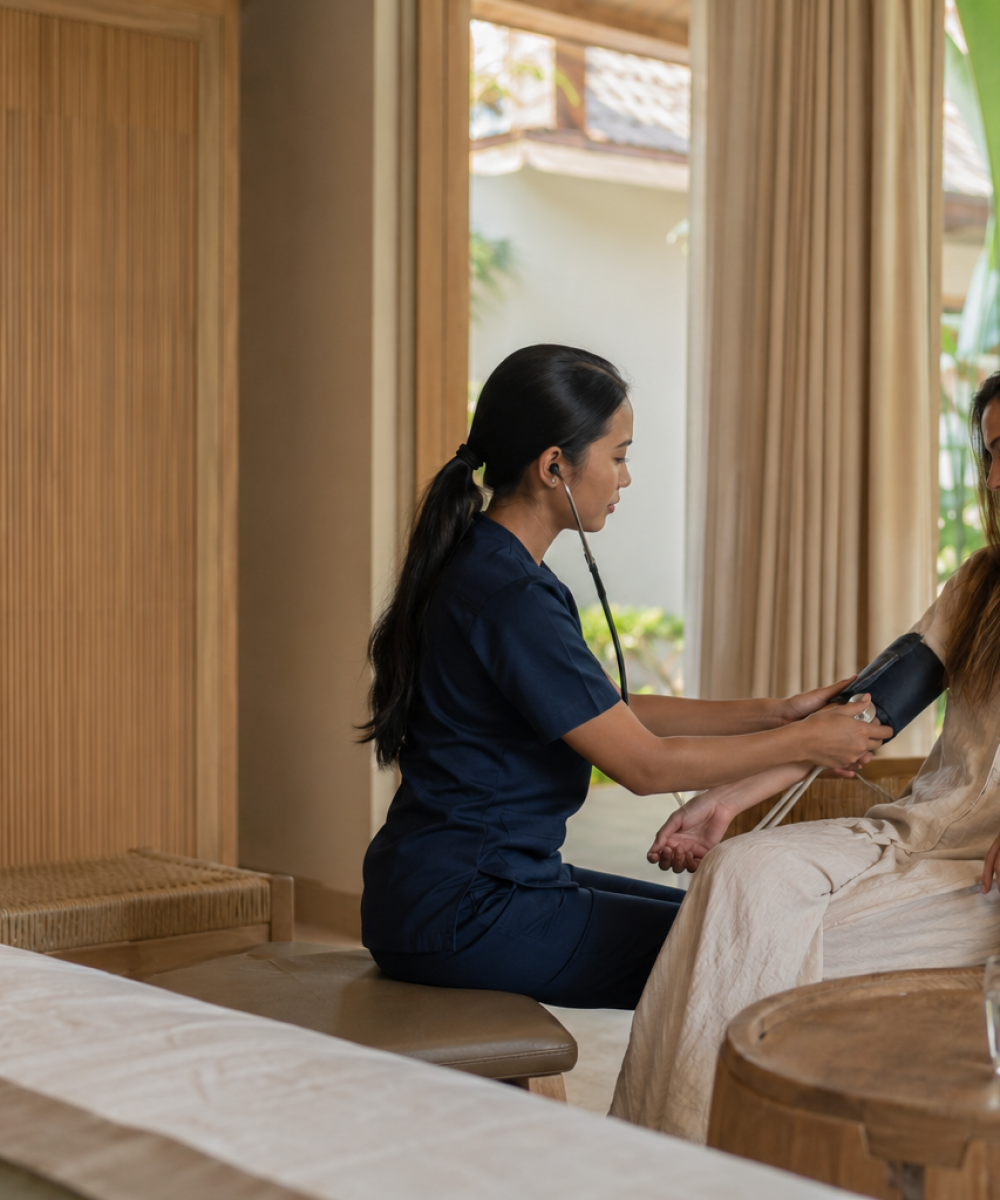
That should cover the obvious things such as accommodation and meals, but also the treatment itself. How much individual counselling is provided? What group work is included? Is medical support available? Is psychiatric assessment available if needed? Are staff on site around the clock?
If detox is required, find out whether it happens on site, whether it is medically supervised and whether it carries an additional fee. You can see how Foundations approaches this on our Medical Detox programme page.
Then look beyond the residential stay. Is family support available? What happens when the programme ends? Is aftercare included or separately priced? Our own approach to continuing support is explained in Aftercare at Foundations Bali.
A lower headline price can become less attractive once several essential components are added separately. Equally, a more expensive programme is not automatically better simply because it includes more amenities.
The useful comparison is what you need, what you receive and what the total cost will actually be.
How much does rehab at Foundations Bali cost?
Foundations keeps its core programme pricing straightforward. You can also see our current programme pricing and payment information on the Costs & Payments page.
7-Day Medical Detox – from USD $5,000
Our 7-Day Medical Detox is designed for people who need clinical support to withdraw safely from alcohol or drugs.
Detox can also form the beginning of residential treatment rather than being treated as the end of treatment itself.
14-Day Reset – from USD $7,500
Our 14-Day Reset is designed for people who cannot initially commit to a longer residential stay.
Where clinically required, detox is incorporated into the programme, followed by an introduction to the wider work of recovery.
We still recommend a longer residential stay where possible. If you begin with 14 days and decide to continue into the full residential programme, you only pay the difference rather than paying for a second programme.
28-Day Residential Rehab – from USD $13,500
Our main Residential Rehab programme starts from USD $15,000 for 28 days.
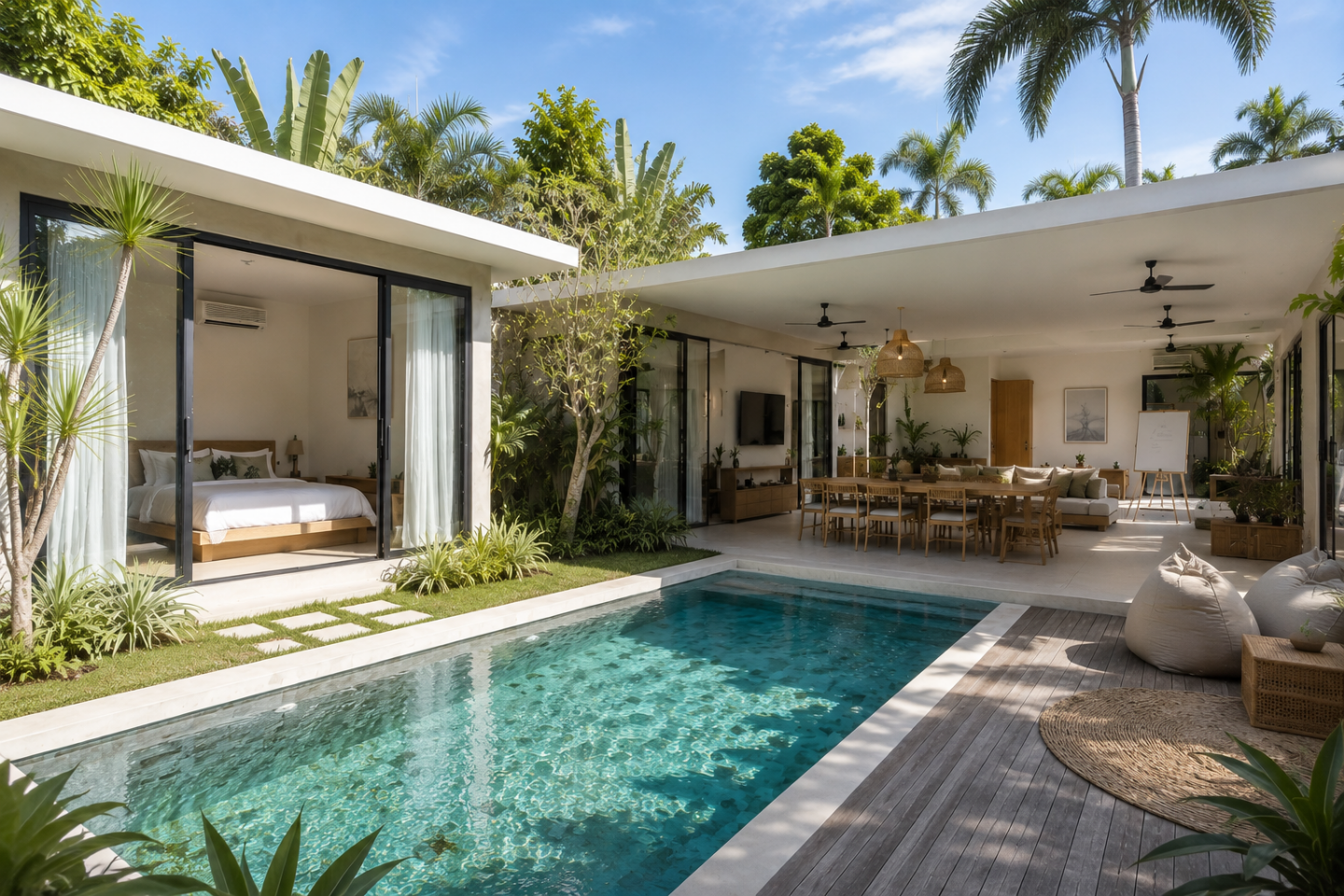
The programme combines accommodation and 24-hour support with clinical and therapeutic treatment, recovery education, individual and group work, meals, movement, activities and the wider experiential programme.
Longer residential stays can also be arranged when more time would be beneficial.
Because Foundations works with a deliberately small number of residents at a time, the programme is designed around individual attention rather than moving large numbers of people through a fixed schedule.
If you are comparing the Foundations fee with another programme, speak to us about exactly what would be included for your situation before making the comparison.

Australia vs Bali: how do rehab costs compare?
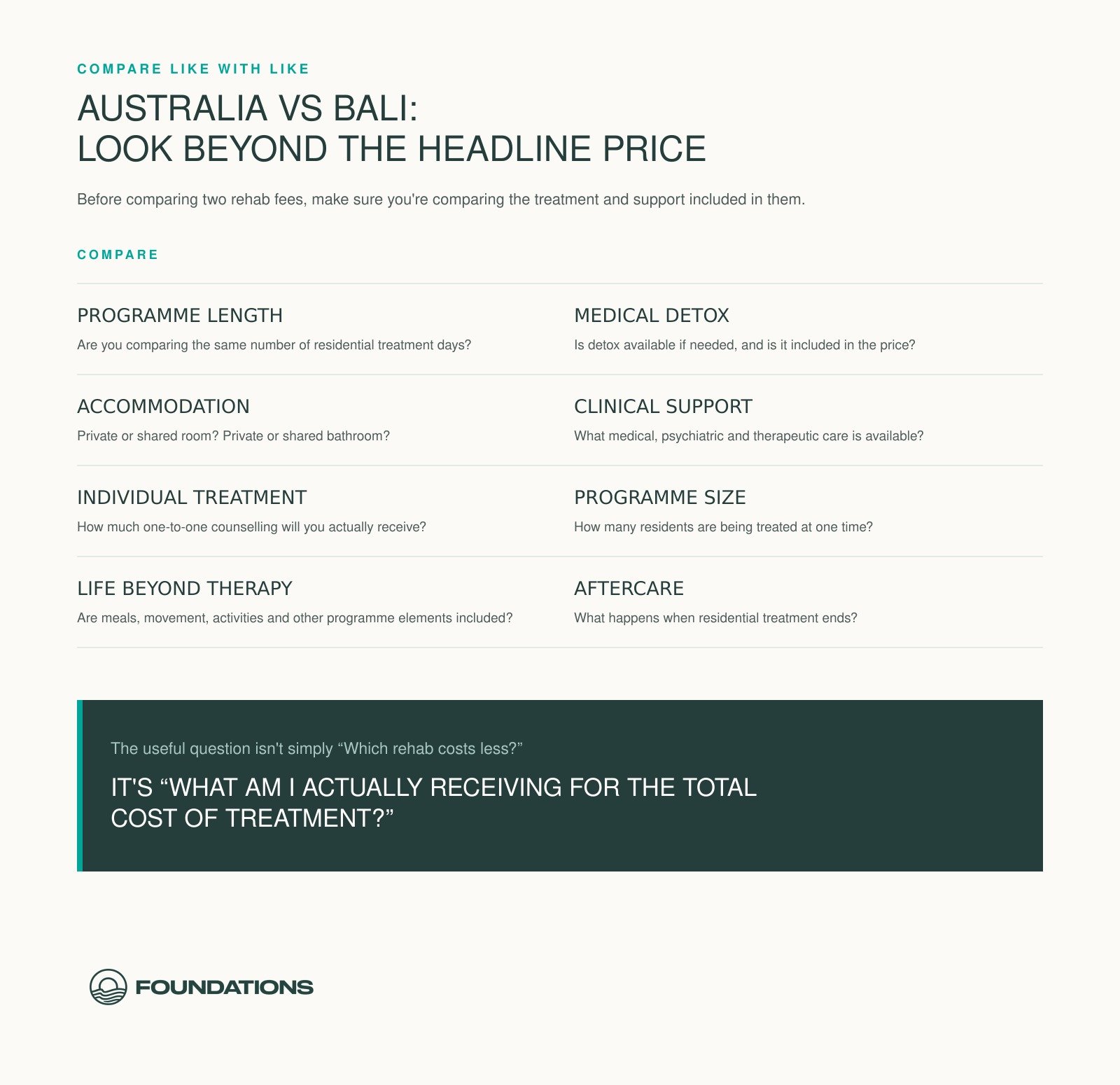
Bali can offer a different cost proposition to private residential treatment in Australia, but “Bali is cheaper” is too simplistic to be useful.
Australia also has free public treatment. Some private hospital treatment may be partly funded through private health insurance. And private Australian residential programmes vary substantially in price.
The comparison becomes more meaningful when somebody is already considering self-funded private residential treatment.
Current published Melbourne pricing puts some 28-day private residential programmes at around AUD $20,000 to $25,000. At the higher end of the private inpatient market, a 28-day stay can approach AUD $39,000 based on current published self-funded rates.
Private residential treatment in Bali can sit at a different price point. Foundations’ 28-day residential programme, for example, starts from USD $13,500.
That price then needs to be considered alongside the AUD/USD exchange rate at the time, flights and other travel costs.
But cost is only half the comparison.
What should you compare between Australian and Bali rehab?
| Consideration | What to check |
|---|---|
| Programme cost | Total residential fee and any additional charges |
| Duration | Whether you are comparing the same number of treatment days |
| Detox | Whether it is required, available and included |
| Accommodation | Private or shared room and bathroom |
| Clinical support | Medical, psychiatric and therapeutic care available |
| Individual treatment | Frequency and type of one-to-one support |
| Group programme | Structure and size of groups |
| Staffing | Level of supervision and support outside therapy hours |
| Meals | Whether all meals are included |
| Activities | What is included and whether there are additional charges |
| Family support | Whether partners or family can be involved |
| Aftercare | What support continues after residential treatment |
| Travel | Flights, entry costs, insurance and transfers |
| Environment | Whether staying close to home or stepping away from it is more useful for you |

For some people, being treated close to home is a significant advantage.
For others, leaving their normal environment is part of the appeal. Physical distance can create space from the routines, people, places and pressures that have become tied to drinking or drug use.
Neither is automatically better. What matters is what will help the individual engage properly with treatment.
What about flights and the cost of travelling to Bali?
If you are comparing Australian treatment with Bali, travel needs to be included in the calculation.
Return flights between major Australian cities and Bali can add several hundred dollars to the overall cost, with fares varying substantially depending on departure city, season, airline and how far ahead you book.
Australian visitors also need to account for Indonesian entry requirements and charges applicable at the time of travel, as well as travel insurance and personal incidental spending.
Rather than relying on a particular airfare as part of your treatment calculation, compare the programme first and then price travel for the dates you are realistically considering.
When you speak to Foundations, we can also explain the arrival process and what transport is included so you know what additional costs to expect.
Does Medicare pay for rehab?
Australia’s funding system means there is no simple yes-or-no answer.
Publicly funded alcohol and drug services may be available free of charge, and Medicare can contribute towards eligible medical and mental health services. Healthdirect recommends asking individual rehabilitation services about costs, fees and any Medicare rebates that may apply.
Private residential rehabilitation does not automatically become Medicare-funded simply because it provides addiction treatment. The way a programme is licensed and delivered matters.
If you are considering a particular Australian provider, ask them directly which parts of treatment attract Medicare benefits, whether there are out-of-pocket costs and what you will be expected to pay yourself.
Does private health insurance cover rehab?
It can.
Private health insurance may contribute towards eligible rehabilitation or inpatient addiction treatment depending on the type of provider and your level of hospital cover.
It is important to distinguish a private hospital addiction programme from a private residential rehabilitation centre. They may both provide addiction treatment, but insurance arrangements can be very different.
The Australian Government explains that hospital cover can contribute towards treatment as a private patient in hospital, subject to the level of cover, waiting periods and other policy conditions. You can read the current government guidance on private hospital cover here.
If you have private health insurance, contact your fund before assuming treatment will or will not be covered. Give them the exact provider and programme you are considering and ask what your total out-of-pocket cost would be.
Can I use my Super to pay for rehab?
Some eligible Australians may be able to apply for early release of superannuation on compassionate grounds to help pay for qualifying medical treatment.
This is not automatic, and having an addiction does not itself guarantee that an application will be approved.
The Australian Taxation Office sets the eligibility requirements for early access to Super on compassionate grounds and assesses applications individually. Supporting evidence is required, and additional considerations can apply where treatment is being sought outside Australia.
Foundations can help you understand the treatment information and documentation relating to your programme, but the decision about early access to Super sits with the relevant Australian authorities and your super fund.
If funding treatment is one of the reasons you are hesitating, read our full guide to using your Super to help pay for rehab before assuming private treatment is financially out of reach.
Is a 14-day rehab programme enough?
Cost is sometimes only part of the reason somebody initially asks about a shorter programme.
Taking a month away from work, children, a business or other responsibilities can feel impossible.
That is why Foundations offers a 14-Day Reset alongside our longer residential programme.
The first priority is safe withdrawal where detox is clinically required. From there, the programme begins the therapeutic and practical work involved in understanding the patterns around addiction and starting recovery.
Fourteen days can provide a meaningful beginning, but we do not present it as equivalent to a longer residential programme.
Where circumstances allow, 28 days remains our stronger starting recommendation for primary residential treatment because it gives you more time to move beyond withdrawal and early stabilisation into the work of changing the behaviours and patterns that keep pulling you back.
If you arrive for the 14-Day Reset and decide that you need more time, you can extend into the full programme and pay only the difference.
You do not need to know exactly how long you need before you speak to us. That is something we can discuss based on what is happening in your life, what you are using, what you have tried before and what support is realistically going to help.
Does more expensive rehab mean better treatment?
No.
Price tells you what a provider charges. On its own, it tells you very little about whether that provider is right for you.
A beautiful room can make residential treatment more comfortable, but it cannot tell you whether the clinical care is good.
An enormous list of therapies does not tell you how much individual attention you will actually receive.
And a high price does not guarantee that the treatment approach is suited to the person entering it.
Look at who is delivering the programme. Check clinical credentials. Ask about medical and psychiatric support. Find out how many residents are treated at once and how much individual counselling is actually provided.
Ask what happens outside scheduled therapy hours. Look at how the programme approaches physical health, relationships and life after treatment. Find out what happens if somebody struggles, relapses or needs more support than initially expected.
And ask what happens after they leave.
A treatment programme should make sense as a whole, not simply look impressive on a price list.
How should I compare rehab costs?

If you are speaking to several treatment providers, ask each of them the same questions. That makes comparison much easier.
Is medical detox included in the quoted price?
If not, find out what it costs and where it takes place.
Is accommodation included?
Ask whether the room and bathroom are private or shared.
How much individual counselling will I receive?
“Individualised treatment” can mean very different things between programmes.
Is medical and psychiatric support available?
Find out who provides it and whether additional appointments carry extra costs.
Are staff available 24 hours a day?
Residential treatment should provide clarity about what support exists outside scheduled programme hours.
Are all meals included?
If you are travelling overseas, also ask about dietary requirements.
Are activities and transport included?
Find out whether advertised programme activities carry additional